Grinding Wheel Selection: Resin vs Ceramic Wheels for Carbon & Stainless Steel
Grinding and cutting quality for metal workpieces largely depends on the bonding type of grinding wheels. In industrial metal processing, carbon steel and stainless steel require completely different grinding parameters due to differences in hardness, ductility and heat resistance. Many manufacturers use universal grinding wheels for all metal materials, resulting in frequent workpiece burning, edge chipping, poor surface finish, rapid wheel wear and low production consistency. Resin-bonded and ceramic-bonded grinding wheels are the two most widely used industrial abrasives for metal cutting and surface grinding. Each features unique hardness, heat resistance, elasticity and self-sharpening performance, delivering distinct results on carbon steel and stainless steel.
A scientific selection cannot rely solely on grit size. It must match the wheel bond type with the workpiece material and processing purpose, whether for fast cutting, heavy stock removal or precision fine grinding. This guide systematically compares resin and ceramic grinding wheels, clarifies their core advantages and limitations, and provides targeted application schemes for carbon steel and stainless steel cutting and grinding scenarios.
1. Resin Bonded Grinding Wheels: Flexible Cutting & Fine Finishing
Resin grinding wheels adopt high-strength resin as the bonding agent, featuring excellent elasticity, strong toughness and good impact resistance. This type of wheel has certain flexibility under high-speed operation, effectively buffering lateral pressure during cutting and grinding to avoid brittle cracking. With fine pore structure and mild cutting performance, resin wheels generate low grinding heat, leaving smooth surface texture without deep grinding traces. Meanwhile, they are easy to trim and maintain stable finishing effects for long-term operation.
Core Advantages: Low thermal deformation, flexible stress relief, smooth cutting, no edge chipping, fine surface finish, high safety for high-speed cutting.
Best Applications
Carbon Steel: Ideal for precision fine grinding, deburring and finish trimming of carbon steel profiles, plates and structural parts. It effectively removes tool marks and oxide layers while protecting workpiece edges from collapse, achieving flat and smooth surface effects. It is also the preferred wheel for small-batch cutting and thin carbon steel sheet processing.
Stainless Steel: The most suitable wheel for stainless steel cutting and finish grinding. Stainless steel is prone to heat accumulation and thermal discoloration during processing. Resin wheels produce low grinding heat, effectively avoiding workpiece burning, blueing and micro-cracks. Their flexible cutting performance prevents scratching and edge chipping on tough stainless steel surfaces, ensuring high-precision finishing quality.
Limitations: Poor heat resistance under long-term heavy-load grinding, easy wear and contour attenuation, not suitable for high-intensity continuous rough grinding and large stock removal scenarios.
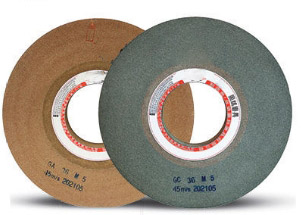
2. Ceramic Bonded Grinding Wheels: High Hardness & Heavy-Duty Grinding
Ceramic (vitrified) grinding wheels use ceramic bonding agents, featuring high rigidity, excellent heat resistance and stable chemical properties. With uniform porous structure, ceramic wheels have strong self-sharpening ability. Passivated abrasive grains fall off automatically during grinding, continuously exposing new sharp cutting edges to maintain stable and efficient cutting performance. They hold shape well with low wear loss, making them suitable for long-term automated batch production.
Core Advantages: High temperature resistance, durable self-sharpening, stable dimensional accuracy, large stock removal, long service life, low replacement frequency.
Best Applications
Carbon Steel: Perfect for heavy-duty rough grinding, weld seam removal, scale cleaning and large-batch cutting of thick carbon steel plates and steel pipes. Ceramic wheels can withstand high grinding pressure and high-temperature friction, achieving fast material removal without passivation. They greatly improve processing efficiency for carbon steel roughing and pretreatment procedures.
Stainless Steel: Suitable for heavy stock removal and rough grinding of high-hardness stainless steel workpieces, such as removing large-area welding spatter and thick oxide layers. However, due to high rigidity and strong cutting force, ceramic wheels are not recommended for stainless steel fine finishing, as they may leave coarse grinding lines and cause edge micro-chipping.
Limitations: Low flexibility, brittle texture, poor pressure resistance, prone to cracking under uneven stress; rigid cutting leads to relatively rough surface finish.
3. Targeted Selection Rules for Carbon Steel & Stainless Steel
Carbon Steel Processing Matching
Rough grinding, weld removal, large-batch cutting → Ceramic Wheels (high efficiency, long life, heavy stock removal)
Fine grinding, surface finishing, thin sheet cutting → Resin Wheels (smooth finish, edge protection, low deformation)
Stainless Steel Processing Matching
Rough removal of thick oxide layers and welding defects → Ceramic Wheels (strong cutting power, stable roughing)
Precision cutting, fine grinding, mirror finishing → Resin Wheels (low heat, no burning, scratch-free surface)
4. Production Optimization Tips
In mass metal production, classified use of grinding wheels is the key to improving yield and reducing costs. Do not use ceramic wheels for stainless steel fine polishing to avoid over-cutting and surface roughness. Do not use resin wheels for long-term heavy carbon steel rough grinding to prevent rapid wheel wear and frequent replacement. Reasonable matching according to processing procedures can balance efficiency, surface quality and consumable cost. In addition, standardized wheel installation and linear speed parameter setting can further avoid workpiece defects and extend wheel service life.
Conclusion
Resin wheels focus on flexible low-heat cutting and high-precision fine finishing, while ceramic wheels excel at high-efficiency heavy-load rough grinding. For carbon steel, combine ceramic rough grinding with resin fine grinding to maximize efficiency and quality. For stainless steel, prioritize resin wheels for cutting and finishing, and use ceramic wheels only for heavy defect removal. Scientific matching of resin and ceramic grinding wheels completely solves common problems such as workpiece burning, edge chipping, poor finish and short wheel life, providing stable and reliable consumable solutions for industrial metal processing.